
-- IFA has long been a useful window into where consumer electronics is heading. This year, one trend stood out: AI is moving beyond software on phones and PCs and into more tangible personal devices. More companies are now asking the same question: if AI is to become a real personal assistant, what form should it take in everyday life?
Among the many AI products shown at IFA 2026, four offer a useful way to explore these different approaches: iKKO MindOne, RayNeo X3 Pro, BleeqUp Ranger, and Plaud NotePin.
One is a compact smartphone, two are smart glasses, and one is a wearable note-taking device. Their forms are very different, but they are all exploring the same idea: how to make AI easier to reach and more natural to use throughout the day.
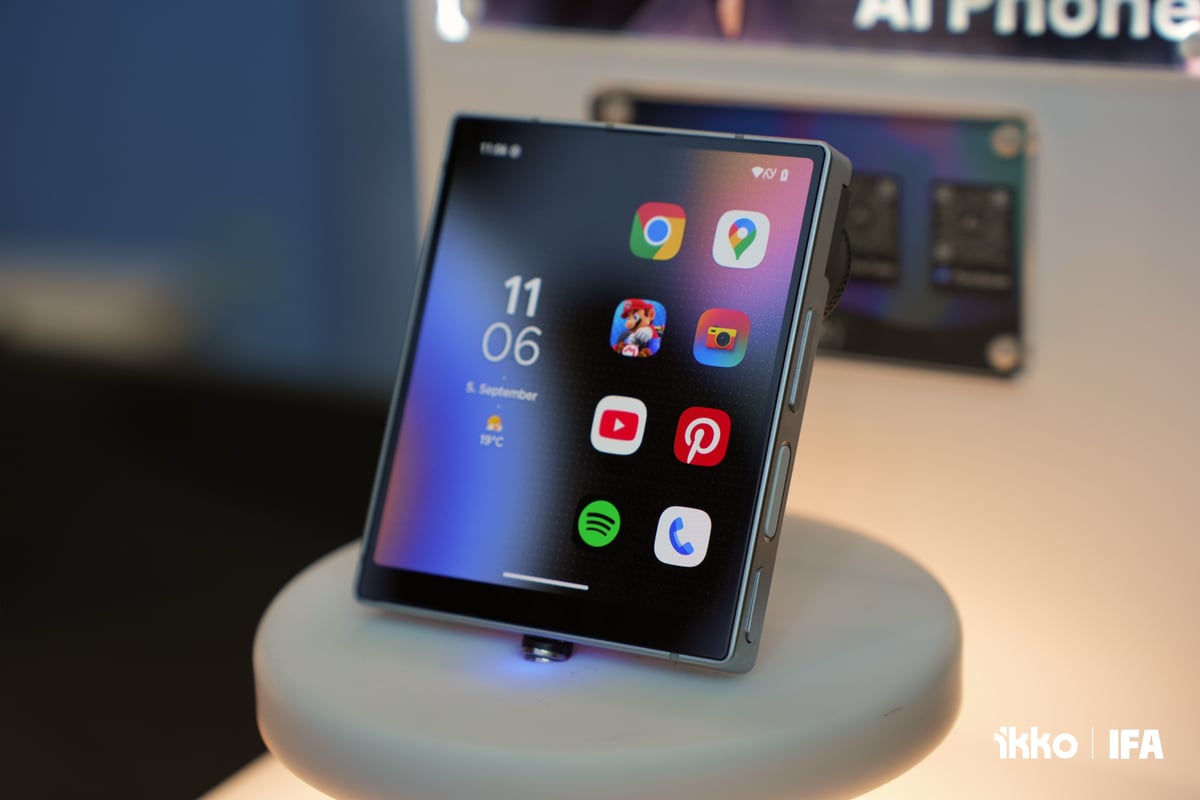
iKKO MindOne: Giving AI Its Own Space on a Small-Screen Phone
At IFA, iKKO MindOne is the kind of device that makes people stop for a closer look. Its shape alone sets it apart from mainstream smartphones. While the industry has spent years moving toward larger screens and more complex hardware, MindOne takes the opposite route.
Its card-sized body measures about 86 × 72 × 8.9 mm, weighs roughly 136 g, and uses an almost square AMOLED display. Its proportions make it look less like a smaller version of a conventional smartphone and more like an attempt to rethink what a phone needs to be.
What makes MindOne more interesting, however, is its approach to AI. Instead of simply adding AI apps to Android, it combines Android 15 with a separate iKKO AI OS. Android handles familiar smartphone tasks, while AI OS provides a dedicated space for tools such as AI Chat, AI Translation, AI Notes, AI Study, and AI Podcast.
On most smartphones, AI tools sit alongside other apps and features. MindOne instead gives them a dedicated environment within iKKO AI OS. AI Notes can help organize meetings, AI Translation can assist while traveling, and AI Podcast can turn long-form content into something easier to listen to on the move.
Another distinctive feature is its 50MP Sony camera, which can flip 180 degrees. One camera handles both front- and rear-facing use, while the flip design allows more flexibility for selfies, video calls, low-angle shots, and group photos.
Connectivity is also divided by purpose. Alongside Nano SIM, vSIM supports mobile data for Android apps, while NovaLink provides connectivity for supported AI tools within iKKO AI OS in supported regions.
MindOne’s significance is therefore not just its unusual size. It raises a broader question: as AI becomes more central to the smartphone experience, should it remain inside individual apps and features, or does it deserve a more direct place in the operating system?
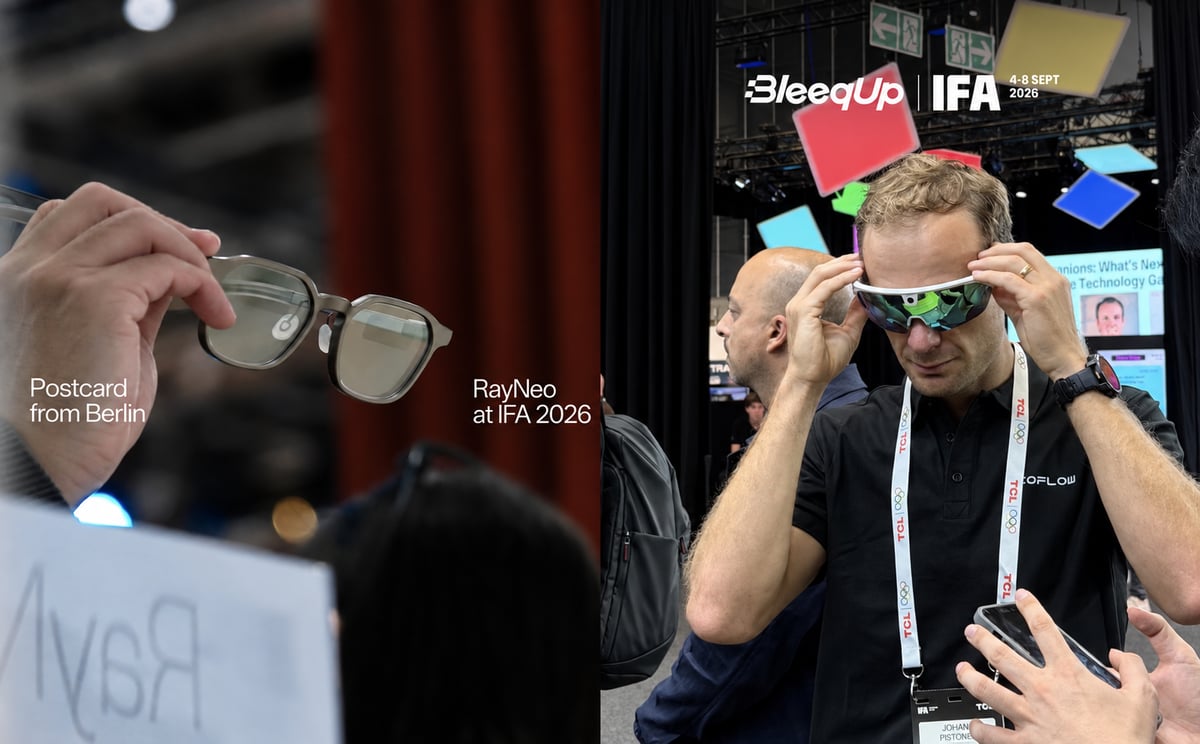
RayNeo X3 Pro: Bringing Useful AI Into the User’s Field of View
RayNeo X3 Pro puts AI assistance and everyday information directly in front of the user. Its full-color binocular MicroLED display offers a resolution of 640 × 480 and a 30-degree field of view, allowing text and visual guidance to appear through the lenses.
Running RayNeo AIOS with Google Gemini integration, the glasses support voice questions, real-time translation, and heads-up navigation. Users can view translated dialogue or check directions without repeatedly reaching for a phone. A built-in camera also supports photo and video capture, while tools such as a teleprompter and meeting transcription extend their use beyond quick questions.
The appeal is clearest in those short moments when checking a screen interrupts what someone is doing. A walking direction or a translated sentence can appear where the user is already looking. RayNeo X3 Pro explores how much of that everyday interaction can move from a handheld screen into a pair of glasses.
BleeqUp Ranger: Bringing AI Into Sports and Everyday Capture
BleeqUp Ranger approaches smart glasses through outdoor activity. It combines a camera, open-ear audio, and calling features in sports eyewear, allowing users to record from their own perspective while keeping their hands free.
The camera offers a 120-degree field of view, with electronic image stabilization to help reduce shake during movement. Open-ear speakers let users listen to audio without covering their ears. BleeqUp lists up to eight hours of audio playback or one hour of continuous recording, making recording time an important consideration for longer outings.
AI comes into the process through editing. BleeqUp’s software can identify highlights in recorded footage and assemble them into shorter videos, reducing the work of reviewing clips after a ride or a run.
That gives Ranger a specific everyday purpose: making an outing easier to capture and the footage easier to use afterward. For someone who regularly records outdoor activities, that follow-up work may be where AI proves most useful.
Plaud NotePin: Letting AI Handle the Work After the Conversation
Plaud NotePin brings AI note-taking into a small wearable device. Weighing about 16.6 g, it can be worn as a pin or clip and used to record meetings, interviews, lectures, and everyday conversations hands-free. Since it requires very little interaction, users can simply let it record while staying focused on the conversation.
Its two MEMS microphones offer a recording range of up to three meters and support up to 20 hours of continuous recording. Once the audio is captured, Plaud can turn it into transcripts, speaker-labeled notes, summaries, and other structured content in 112 languages.
What makes NotePin useful is that it does not ask users to change how they take part in a conversation. They can stay focused on listening and speaking, while the device handles the recording in the background. Afterward, AI takes care of much of the follow-up work, from transcription and organization to summaries and action items.
IFA Is Becoming a Testing Ground for AI Hardware
These products make one thing clear: AI hardware is still finding its shape. There is no single answer yet. Phones, glasses, and wearable note-taking devices are all exploring different ways to bring AI closer to the user.
MindOne stands out because it does more than add a few AI features to a phone. By giving AI its own place at the system level, it offers a different way to think about how people might interact with AI on a daily basis. If iKKO AI OS continues to improve, add more practical use cases, and connect with more personal services, MindOne could become a more distinctive kind of personal AI device.
The challenge now is not simply adding more AI features, but making them useful enough that people actually want to use them every day without giving up what they already expect from familiar devices.
That is what makes IFA interesting right now. Over the next few years, no single device may replace everything else. Instead, different products are likely to keep moving in the same direction: making AI easier to access and more natural to use in everyday life.
Contact Info:
Name: Claire
Email: Send Email
Organization: iKKO
Website: https://ikko.com/
Release ID: 89204496
Should you come across any errors, concerns, or inconsistencies within this press release's content, we urge you to reach out without delay by contacting [email protected] (it is important to note that this email is the authorized channel for such matters, sending multiple emails to multiple addresses does not necessarily help expedite your request). Our committed team will promptly address your feedback within 8 hours and take appropriate measures to resolve any identified issues or guide you through the removal process. Providing accurate and dependable information remains our utmost priority.



